Homemade Juggling Beanbag Guide > Individual Post
Change the image content filter setting. The filter is currently set to full filtering.


Downloading content. Please wait...
Individual Post and Any Replies
Name:
Hali
Date:
Nov. 10, 2025, 9:54pm
Comments:
This is exactly what I've been looking for and more! Thank you so much for making such a great and comprehensive resource and putting it out for free!!! As an educator who writes free sewing documents myself, I can tell you have spent a lot of time making this well organized and comprehensive. I'll come back and leave comments on the sewing instruction if you'd like, or if I feel it's relevant after going through your guide more thoroughly.
I do think that the leather juggling balls you have pictured at the top of page 77 of your guide are AI generated. The website they link too seems to use AI images elsewhere on their site as well. I appreciate how thoroughly you source and link everything you put in your guide though because it made it very easy to do more sleuthing about it.
I'm so excited to get started that I think I will make one of all 15 ball patterns to see which one I like best!
I do think that the leather juggling balls you have pictured at the top of page 77 of your guide are AI generated. The website they link too seems to use AI images elsewhere on their site as well. I appreciate how thoroughly you source and link everything you put in your guide though because it made it very easy to do more sleuthing about it.
I'm so excited to get started that I think I will make one of all 15 ball patterns to see which one I like best!

Replies

Re: Hali (main post)
Name:
Joshua Clifton
Date:
Nov. 11, 2025, 12:41pm
A Good Quote:
As iron sharpens iron, so one person sharpens another [and his works].
Comments:
Hali,
Thank you so much for your post! Thank you for making the effort to point out shortcomings in it, and for expressing its value to you and your recognition of the quality of what I created! This is the kind of feedback I long for, but rarely get! People like you not only encourage and uplift me, but also further validate all the time and work I have put into this project. It was profoundly fun and fulfilling to do and gave me a hobby when I had no other, and so was wholly worthwhile even if nobody ever made use of it, but it feels so much more so knowing that people like you are using it, enjoying it, and appreciating it!
And I believe you are right about the juggling ball images on page 77 being AI-generated. Thank you for confirming my suspicion about that. I always thought they looked a little fishy, but I wasn't sure, and the balls were very lovely-looking. So, while I wasn't sure if panel structures like those were actually possible to design, and while the images themselves looked a little too pristine (and the brown ball on the lower-left in the middle image appears to have misaligned polar cap panels and incorrectly perspective-distorted orange peel panels), I have seen enough real examples of extremely intricate panel structures that I kept the images in, despite their dubious origin. (I feel I should have realized that these were AI-generated, but I was not as sensitive to recognizing AI images at the time I added those images.) But now that you have confirmed my suspicion, I have removed those images, leaving only the link to the website and a brief description of it. AI schlock and fake ball designs do NOT belong in my document! Eww. Gross.
(For anyone who is curious about the images to which we are referring, which are no longer in my document: https://www.jugglingballs.com.au/how-to-make-leather-juggling-balls/.)
Again, I offer you my sincere and heartfelt gratitude, Hali! If you are willing, I would love to see updates from you (here or via email) showing the balls you make, and any uses you have found for my information, either in your personal life or in your work as an educator, as well as any further critiques, suggestions, or problems you find in my documents. If you do make one of every design, you will be the ideal person to let me know if my instructions, patterns, document design, and everything else work well for you, and are intuitive and clear. I have really needed an editor to proof-read and test my documents and check for errors I am blind to, or help improve the layout, illustrations, and wording of everything. I have had only my own perspective to go on so far, and as any writer knows, it is difficult (if not even quite possible) to properly edit one's own work, since I cannot see it from an objective perspective.
This hobby is now ended as of around the beginning of this year, and I have no hobby or project to replace it so far, but you may spark a renewed interest in it!
If you want to add any links, images, or further info to your main post, rather than in a reply (so other readers are more likely to see what you have added), email them to me and I can edit your post for you. My website is not sophisticated enough to allow users to create accounts so they can log in and edit their own posts after submitting them and closing the browser window, but I have that power ;-).
If you want to add photos of your balls to show other readers and do not have a way to make them available on the web, send them to me and I can upload them to my server and create links to them in your post. My forum does not have the ability to embed images in a post, so the only option is to provide links to the images.
Keep in touch, and happy crafting!
Thank you so much for your post! Thank you for making the effort to point out shortcomings in it, and for expressing its value to you and your recognition of the quality of what I created! This is the kind of feedback I long for, but rarely get! People like you not only encourage and uplift me, but also further validate all the time and work I have put into this project. It was profoundly fun and fulfilling to do and gave me a hobby when I had no other, and so was wholly worthwhile even if nobody ever made use of it, but it feels so much more so knowing that people like you are using it, enjoying it, and appreciating it!
And I believe you are right about the juggling ball images on page 77 being AI-generated. Thank you for confirming my suspicion about that. I always thought they looked a little fishy, but I wasn't sure, and the balls were very lovely-looking. So, while I wasn't sure if panel structures like those were actually possible to design, and while the images themselves looked a little too pristine (and the brown ball on the lower-left in the middle image appears to have misaligned polar cap panels and incorrectly perspective-distorted orange peel panels), I have seen enough real examples of extremely intricate panel structures that I kept the images in, despite their dubious origin. (I feel I should have realized that these were AI-generated, but I was not as sensitive to recognizing AI images at the time I added those images.) But now that you have confirmed my suspicion, I have removed those images, leaving only the link to the website and a brief description of it. AI schlock and fake ball designs do NOT belong in my document! Eww. Gross.
(For anyone who is curious about the images to which we are referring, which are no longer in my document: https://www.jugglingballs.com.au/how-to-make-leather-juggling-balls/.)
Again, I offer you my sincere and heartfelt gratitude, Hali! If you are willing, I would love to see updates from you (here or via email) showing the balls you make, and any uses you have found for my information, either in your personal life or in your work as an educator, as well as any further critiques, suggestions, or problems you find in my documents. If you do make one of every design, you will be the ideal person to let me know if my instructions, patterns, document design, and everything else work well for you, and are intuitive and clear. I have really needed an editor to proof-read and test my documents and check for errors I am blind to, or help improve the layout, illustrations, and wording of everything. I have had only my own perspective to go on so far, and as any writer knows, it is difficult (if not even quite possible) to properly edit one's own work, since I cannot see it from an objective perspective.
This hobby is now ended as of around the beginning of this year, and I have no hobby or project to replace it so far, but you may spark a renewed interest in it!
If you want to add any links, images, or further info to your main post, rather than in a reply (so other readers are more likely to see what you have added), email them to me and I can edit your post for you. My website is not sophisticated enough to allow users to create accounts so they can log in and edit their own posts after submitting them and closing the browser window, but I have that power ;-).
If you want to add photos of your balls to show other readers and do not have a way to make them available on the web, send them to me and I can upload them to my server and create links to them in your post. My forum does not have the ability to embed images in a post, so the only option is to provide links to the images.
Keep in touch, and happy crafting!
#1
Re: Joshua Clifton (reply #1)
Name:
Hali
Date:
Nov. 14, 2025, 11:07pm
A Wise Man Once Said ~
Measure twice, cut also twice because you missed a compounding error somewhere...
Comments:
My plan currently is to make each ball 2.3in and 80g out of 1mm black pleather, so that they can be hand sewn while still having a leather look. They'll be for me for juggling and I am a relatively small handed individual. I have to make a a couple test balls first of course to be sure this is what I like and want! But I am hopeful they will be a striking set all completed.
I've taken the time to print out all of the separate instruction PDFs, that way I can make notes on them and reference them while sewing. It's quite a tome! Once again I must commend you on the amount of work you've put into this to just give it out for free. Very impressive dedication! Wonderful hobby choice!
The one thing I am a little confused about right now is the cutting patterns. The stitching patterns make sense to me, as an edge to edge construction with pre-placed stitch holes. I'm more used to having patterns labeled as seam allowance and no seam allowance, but for the cutting patterns, there are 3 to 4 lines around each panel piece and I can't work out why, or which one relates to what to be honest. That being said, I haven't had time to read the instructions front to back yet, so I feel likely to figure it out.
I have unfettered access to a laser cutter, so I will probably be converting all your patterns to SVGs and then cutting them all at once. I'm still undecided if I will laser the stitch holes in... might be nice, but I might machine sew them which will negate the purpose of pre-placed holes. But laser cutting does mean figuring out what each of the lines around the cutting patterns are for so I can mark things accurately. I can engrave reference lines on the surface of the pleather, as opposed to cutting all the way through, so it's worth figuring out what all I want and need in the SVG.
I will definitely keep you updated! Depending on how many notes/comments I have I think I will try to send you an email per chapter of my thoughts, feedback, and photos. That being said I think I should make maybe four balls or so to really get a sense for what works and doesn't and what is truly confusing or not, that way I'm not sending initial thoughts as much as practiced ones. So it may be a little bit before those updates start coming in!
Feel free to reach out to me as well with my email from my original post if you have any questions or anything about how I'm going about things :) or if you want I can send you some of my sewing documents. Though I must warn you that mine are for college design students who have never sewn before, so they can be very basic at times.
I've taken the time to print out all of the separate instruction PDFs, that way I can make notes on them and reference them while sewing. It's quite a tome! Once again I must commend you on the amount of work you've put into this to just give it out for free. Very impressive dedication! Wonderful hobby choice!
The one thing I am a little confused about right now is the cutting patterns. The stitching patterns make sense to me, as an edge to edge construction with pre-placed stitch holes. I'm more used to having patterns labeled as seam allowance and no seam allowance, but for the cutting patterns, there are 3 to 4 lines around each panel piece and I can't work out why, or which one relates to what to be honest. That being said, I haven't had time to read the instructions front to back yet, so I feel likely to figure it out.
I have unfettered access to a laser cutter, so I will probably be converting all your patterns to SVGs and then cutting them all at once. I'm still undecided if I will laser the stitch holes in... might be nice, but I might machine sew them which will negate the purpose of pre-placed holes. But laser cutting does mean figuring out what each of the lines around the cutting patterns are for so I can mark things accurately. I can engrave reference lines on the surface of the pleather, as opposed to cutting all the way through, so it's worth figuring out what all I want and need in the SVG.
I will definitely keep you updated! Depending on how many notes/comments I have I think I will try to send you an email per chapter of my thoughts, feedback, and photos. That being said I think I should make maybe four balls or so to really get a sense for what works and doesn't and what is truly confusing or not, that way I'm not sending initial thoughts as much as practiced ones. So it may be a little bit before those updates start coming in!
Feel free to reach out to me as well with my email from my original post if you have any questions or anything about how I'm going about things :) or if you want I can send you some of my sewing documents. Though I must warn you that mine are for college design students who have never sewn before, so they can be very basic at times.
#2
Re: Hali (reply #2)
Name:
Joshua the awed
Date:
Nov. 15, 2025, 9:09am
Comments:
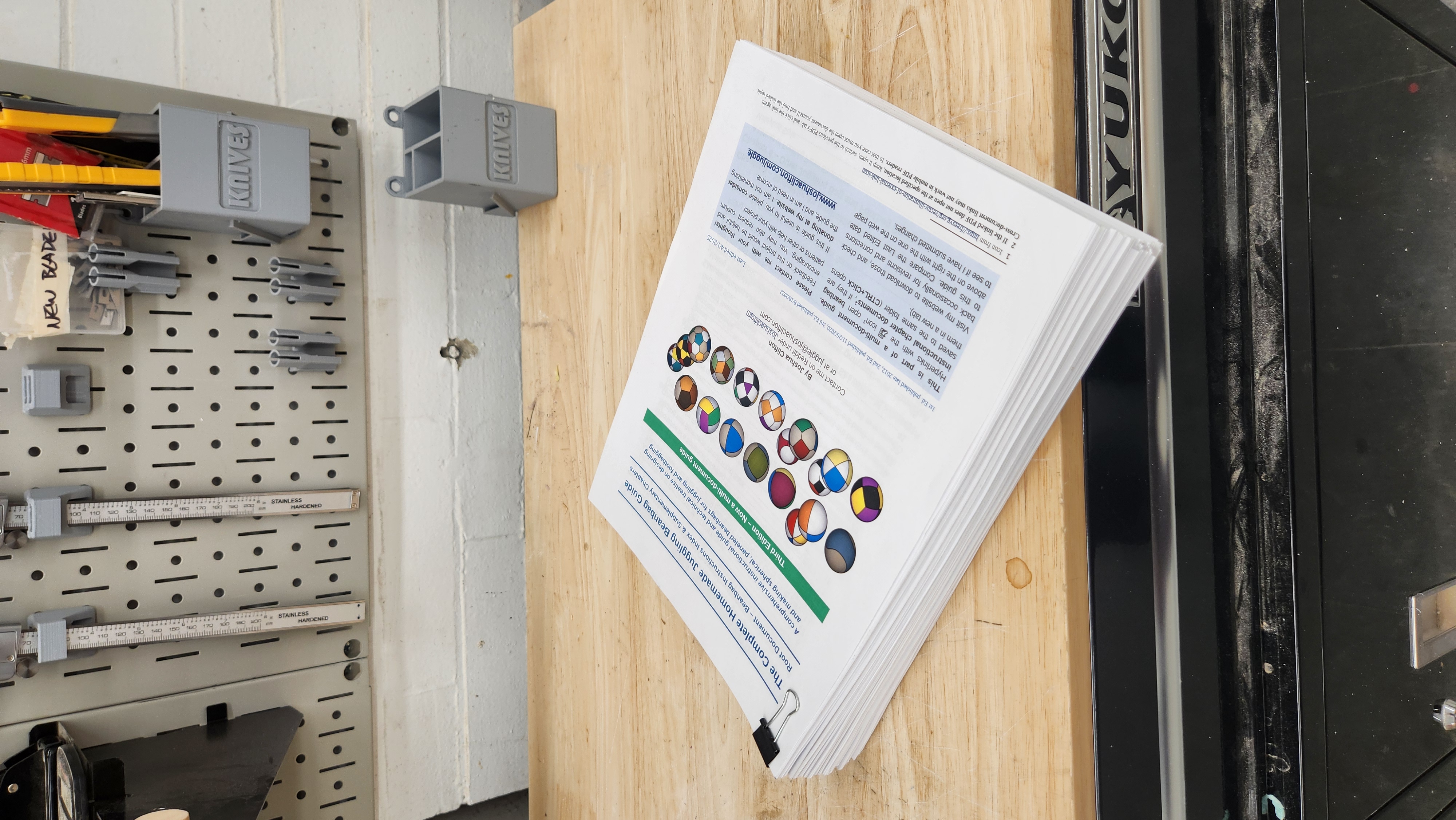
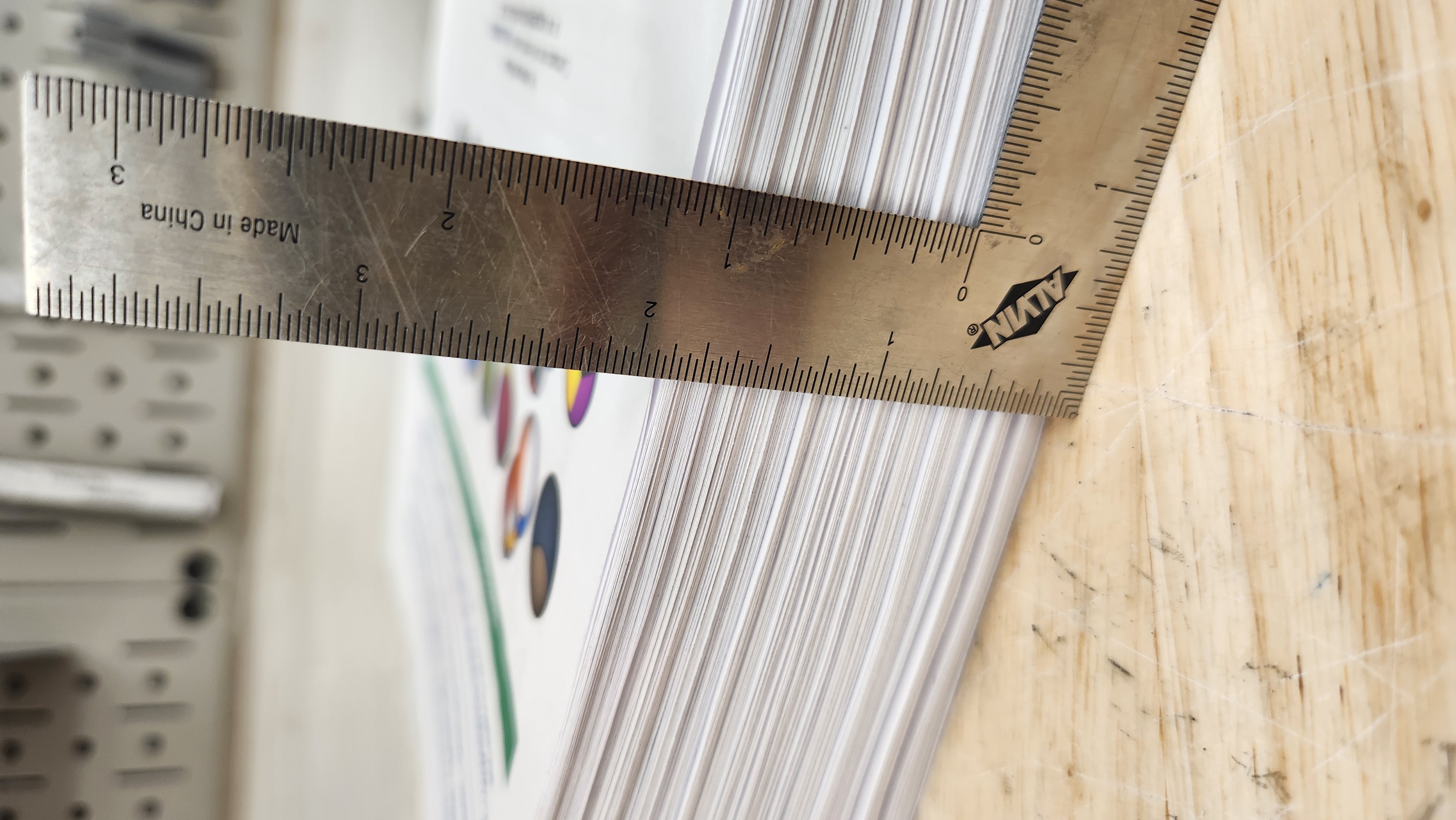
Below are Hali's photos of my ENTIRE guide printed out double sided at 8.5×11. It amounted to being almost two inches thick! (770 pages, 385 sheets.)
https://www.joshuaclifton.com/juggle/forumpics/my_site/Tome1000022729.jpg
https://www.joshuaclifton.com/juggle/forumpics/my_site/Tome1000022731.jpg
Ok, I have a number of thoughts on this...
First, I love your "wise man's saying" LOL! What a hilarious, and true, subversion of expectation! I love that you played along with me by including that!
1) My GOD that is a lot of printing! I never envisioned that anybody would print ALL my documents in their ENTIRETY, (just small portions for quick reference, perhaps), especially since it is really meant as an electronic document, having hyperlinks!! However, I did intentionally make it printable, and even (I hope) mountable in a 3-ring binder, having (barely) sufficient margins. I had in mind an Amish or elderly person who wasn't comfortable with (or had no access to) computers having a friend print a set of instructions and patterns for them.
2) You are awesome for being so dedicated to using and critiquing my documents! Thank you even for simply sharing those photos with me, since, yes, I have never seen my guide printed! You're probably the only person in the world, now or in the future, ever to do that! I love you for doing all this!
3) I had about three more reactions late last night during my insomnia when I first saw your email (but not your reply here yet), but I'm having trouble remembering them... Hmm, I'll edit this later when I think of them... I would have taken notes, but I was finally ready to fall asleep and didn't want to key up my emotions again!
https://www.joshuaclifton.com/juggle/forumpics/my_site/Tome1000022729.jpg
https://www.joshuaclifton.com/juggle/forumpics/my_site/Tome1000022731.jpg
Ok, I have a number of thoughts on this...
First, I love your "wise man's saying" LOL! What a hilarious, and true, subversion of expectation! I love that you played along with me by including that!
1) My GOD that is a lot of printing! I never envisioned that anybody would print ALL my documents in their ENTIRETY, (just small portions for quick reference, perhaps), especially since it is really meant as an electronic document, having hyperlinks!! However, I did intentionally make it printable, and even (I hope) mountable in a 3-ring binder, having (barely) sufficient margins. I had in mind an Amish or elderly person who wasn't comfortable with (or had no access to) computers having a friend print a set of instructions and patterns for them.
2) You are awesome for being so dedicated to using and critiquing my documents! Thank you even for simply sharing those photos with me, since, yes, I have never seen my guide printed! You're probably the only person in the world, now or in the future, ever to do that! I love you for doing all this!
3) I had about three more reactions late last night during my insomnia when I first saw your email (but not your reply here yet), but I'm having trouble remembering them... Hmm, I'll edit this later when I think of them... I would have taken notes, but I was finally ready to fall asleep and didn't want to key up my emotions again!
#3
Re: Hali (reply #2)
Name:
Joshua Clifton
Date:
Nov. 15, 2025, 9:31am
Comments:
Oh, as for the cutting patterns, that's the kind of thing I understand because I designed it, but others may be confused by, and so I need outside help to make it intuitive. The page preceding each set of patterns explains this. So please...
1) Tell me if I should change my pattern design to make them more understandable to those who didn't read my pattern description/instruction page. I realize that most people won't read much at all of my documents and will just dive right into printing the patterns and trying to use them. So, while I have tried to make my instructions as concise and easy to use & understand as I can, I would like them not to be NECESSARY to read in order to make use of the patterns.
2) Read that instruction page and tell me if you now understand. I don't want to explain it to you yet, because I want to see if my description of the patterns explains it sufficiently. Also, let me know if you understand the purpose of the awl hole markers. Let me know if it is clear WHEN, and especially WHEN NOT, to use/pay attention to them.
3) Tell me if I can make my pattern design, especially the decorative & meta elements, easier for converting to SVG. Another reader told me he had difficulty converting the patterns because the background elements (the centimeter grid and 3D ball) confused the program. He was not able to help me come up with a way to convert my own patterns into SVG, and embed those into my documents instead of as mere JPEG images. I don't have experience with or understanding of this. I would like my pattern pages to retain both the pattern line and fill designs themselves, and also, preferably, but not necessarily, the aesthetic and meta elements.
In short, I want my patterns to be as convenient and intuitive to use as possible for all modes of use, while also being attractive and distinctive, and maybe you can help me achieve that!
EDIT:
To help you help me to improve my pattern presentation, here is my process for creating the pattern pages.
1) I create the patterns, including all line elements, in Sketchup, and export each entire page of patterns as a PNG in precisely my desired DPI (600 pixels per inch of the full page). (Actually, I export several different elements of the patterns individually so that I can more easily perform the next step.)
2) I import that into Photoshop to thicken the lines, add fill, separate out different image layers so I can make some pattern elements gray and others black, or different thicknesses, and be able to edit, or later improve, any individual layer. I also add the title, footer, and the grid and other background image elements.
3) I export that full page as a PNG and embed it into my document at precisely the right physical size so that it will produce the correct print size.
1) Tell me if I should change my pattern design to make them more understandable to those who didn't read my pattern description/instruction page. I realize that most people won't read much at all of my documents and will just dive right into printing the patterns and trying to use them. So, while I have tried to make my instructions as concise and easy to use & understand as I can, I would like them not to be NECESSARY to read in order to make use of the patterns.
2) Read that instruction page and tell me if you now understand. I don't want to explain it to you yet, because I want to see if my description of the patterns explains it sufficiently. Also, let me know if you understand the purpose of the awl hole markers. Let me know if it is clear WHEN, and especially WHEN NOT, to use/pay attention to them.
3) Tell me if I can make my pattern design, especially the decorative & meta elements, easier for converting to SVG. Another reader told me he had difficulty converting the patterns because the background elements (the centimeter grid and 3D ball) confused the program. He was not able to help me come up with a way to convert my own patterns into SVG, and embed those into my documents instead of as mere JPEG images. I don't have experience with or understanding of this. I would like my pattern pages to retain both the pattern line and fill designs themselves, and also, preferably, but not necessarily, the aesthetic and meta elements.
In short, I want my patterns to be as convenient and intuitive to use as possible for all modes of use, while also being attractive and distinctive, and maybe you can help me achieve that!
EDIT:
To help you help me to improve my pattern presentation, here is my process for creating the pattern pages.
1) I create the patterns, including all line elements, in Sketchup, and export each entire page of patterns as a PNG in precisely my desired DPI (600 pixels per inch of the full page). (Actually, I export several different elements of the patterns individually so that I can more easily perform the next step.)
2) I import that into Photoshop to thicken the lines, add fill, separate out different image layers so I can make some pattern elements gray and others black, or different thicknesses, and be able to edit, or later improve, any individual layer. I also add the title, footer, and the grid and other background image elements.
3) I export that full page as a PNG and embed it into my document at precisely the right physical size so that it will produce the correct print size.
#4
Re: Joshua Clifton (reply #4)
Name:
Hali
Date:
Nov. 18, 2025, 11:04pm
Comments:
Responses -
1) Would it be impolite to completely edit and reformat a ball guide and send it to you? I can tell you all the things I would change instead and send you your own document back laden with notes if you prefer, I just think that would take a lot more time and explanation than just showing what I think would be a good edited version.
I am not through them as much as I would hope to be before giving feedback, but so far I would give your manuals for the baseball and orange peel ball a C+ for ease of use and understandability. Very much a passing grade! But I think you are already aware that the guides have a lot that could be pared down, as per your comment that
"I realize that most people won't read much at all of my documents and will just dive right into printing the patterns and trying to use them."
There is a LOT of really helpful information in here that's getting lost in the weeds, so to speak.
Related, I think it's very meaningful that you mentioned the goal of your document in your core guide when you said
"The original purpose of this document was to provide mathematical definitions, not mere patterns,
for spherical beanbag designs so hobbyists can create their own patterns for any beanbag size, and
understand the derivation of the designs and improve or adjust them if they wish. (In the Second
Edition I began shifting the emphasis to the ready-to-print patterns, but I still provide the pattern
definitions.)"
You also just mentioned a goal in the last message
"I want my patterns to be as convenient and intuitive to use as possible for all modes of use, while also being attractive and distinctive"
I love to hear a goal stated outright like this, it lets the reader know exactly why you've included the information you've included. That being said, I think ready-to-use, intuitive, and convenient might be a bit of a conflicting goal to mathematical definitions, derivations, and minutiae of how you arrived at each pattern. I think both can and should remain, but each would benefit from being separated.
For clarity, If you want and I were to send you an edited ball guide, I would focus on your secondary goal of ready-to-print patterns with clear instructions and cut all the things that I don't think support that goal efficiently. Then add a statement at the end that ! the mathematical definitions and more exist here ! if an individual _chooses_ to get into those weeds.
Knowing how many jugglers are mathematicians, I am sure they will!
2) After reading I do now understand that there is a 4mm, 6mm, and 8mm seam allowance lines. I think this could easily be added to the pattern page in a key if the lines were different colors or patterns (dashed, dotted and dashed, solid, etc.) Awl hole markers make sense to me for visible stitching/lacing such as for use with leather. The brief mention of that on the pattern page meant I picked up on that quickly! I think it would also be helpful to have them be another color or something for visual shorthand that they aren't necessarily part of the core pattern.
3) In terms of ease of converting to SVG I may need to follow one of your tutorials for drawing the pattern pieces in SketchUp to help you there. I fear it may mean changing your pattern making flow entirely from the jump. There is simply no easy way to go from photoshop, with pattern fills and PNG text, to an SVG. You mention exporting several different elements from SketchUp before the photoshop stage - that is likely the easiest material to convert to an SVG, but again I would have to try it myself I think. The background elements do make it difficult.
Unfortunately I just use the expensive, and often inaccessible to the average person, Adobe Illustrator for drawing up SVGs. The manual drawing portion of each guide is helpful for doing that myself actually. Adobe Illustrator also allows you to select your pattern line and automatically generate an offset line at any distance for seam allowance, as well as make lines different patterns. I would be fine with giving you my completed Illustrator files and SVGs when I'm done making them if you want to link them in your document. That may be the easiest way unfortunately. I am still working out the workflow for myself on this one.
Closing Notes -
I still don't have any completed SVGs or balls because I have been spending so much time just reading and understanding the document!!! Whoops! So I do not have any feedback on the patterns or sewing or scaling or anything like that. I am somewhere in chapter two of the core guide, and have done a cursory read through of both the baseball and orange peel ball guides. I have lots of notes to show for it, if not any balls.
I still don't know how bias cutting resulted in a lemon shaped ball for you, but I will be into cutting and sewing soon I hope. I am very grain direction aware, so I am sure that I will have lots of notes on that front once I have my own balls to show for it. Also, if you would prefer this kind of feedback as an email let me know. I didn't think I would be sending this reply off today, but here I am. Hopefully this is a helpful update. I wanted to respond to your questions a little more promptly at least.
1) Would it be impolite to completely edit and reformat a ball guide and send it to you? I can tell you all the things I would change instead and send you your own document back laden with notes if you prefer, I just think that would take a lot more time and explanation than just showing what I think would be a good edited version.
I am not through them as much as I would hope to be before giving feedback, but so far I would give your manuals for the baseball and orange peel ball a C+ for ease of use and understandability. Very much a passing grade! But I think you are already aware that the guides have a lot that could be pared down, as per your comment that
"I realize that most people won't read much at all of my documents and will just dive right into printing the patterns and trying to use them."
There is a LOT of really helpful information in here that's getting lost in the weeds, so to speak.
Related, I think it's very meaningful that you mentioned the goal of your document in your core guide when you said
"The original purpose of this document was to provide mathematical definitions, not mere patterns,
for spherical beanbag designs so hobbyists can create their own patterns for any beanbag size, and
understand the derivation of the designs and improve or adjust them if they wish. (In the Second
Edition I began shifting the emphasis to the ready-to-print patterns, but I still provide the pattern
definitions.)"
You also just mentioned a goal in the last message
"I want my patterns to be as convenient and intuitive to use as possible for all modes of use, while also being attractive and distinctive"
I love to hear a goal stated outright like this, it lets the reader know exactly why you've included the information you've included. That being said, I think ready-to-use, intuitive, and convenient might be a bit of a conflicting goal to mathematical definitions, derivations, and minutiae of how you arrived at each pattern. I think both can and should remain, but each would benefit from being separated.
For clarity, If you want and I were to send you an edited ball guide, I would focus on your secondary goal of ready-to-print patterns with clear instructions and cut all the things that I don't think support that goal efficiently. Then add a statement at the end that ! the mathematical definitions and more exist here ! if an individual _chooses_ to get into those weeds.
Knowing how many jugglers are mathematicians, I am sure they will!
2) After reading I do now understand that there is a 4mm, 6mm, and 8mm seam allowance lines. I think this could easily be added to the pattern page in a key if the lines were different colors or patterns (dashed, dotted and dashed, solid, etc.) Awl hole markers make sense to me for visible stitching/lacing such as for use with leather. The brief mention of that on the pattern page meant I picked up on that quickly! I think it would also be helpful to have them be another color or something for visual shorthand that they aren't necessarily part of the core pattern.
3) In terms of ease of converting to SVG I may need to follow one of your tutorials for drawing the pattern pieces in SketchUp to help you there. I fear it may mean changing your pattern making flow entirely from the jump. There is simply no easy way to go from photoshop, with pattern fills and PNG text, to an SVG. You mention exporting several different elements from SketchUp before the photoshop stage - that is likely the easiest material to convert to an SVG, but again I would have to try it myself I think. The background elements do make it difficult.
Unfortunately I just use the expensive, and often inaccessible to the average person, Adobe Illustrator for drawing up SVGs. The manual drawing portion of each guide is helpful for doing that myself actually. Adobe Illustrator also allows you to select your pattern line and automatically generate an offset line at any distance for seam allowance, as well as make lines different patterns. I would be fine with giving you my completed Illustrator files and SVGs when I'm done making them if you want to link them in your document. That may be the easiest way unfortunately. I am still working out the workflow for myself on this one.
Closing Notes -
I still don't have any completed SVGs or balls because I have been spending so much time just reading and understanding the document!!! Whoops! So I do not have any feedback on the patterns or sewing or scaling or anything like that. I am somewhere in chapter two of the core guide, and have done a cursory read through of both the baseball and orange peel ball guides. I have lots of notes to show for it, if not any balls.
I still don't know how bias cutting resulted in a lemon shaped ball for you, but I will be into cutting and sewing soon I hope. I am very grain direction aware, so I am sure that I will have lots of notes on that front once I have my own balls to show for it. Also, if you would prefer this kind of feedback as an email let me know. I didn't think I would be sending this reply off today, but here I am. Hopefully this is a helpful update. I wanted to respond to your questions a little more promptly at least.
#5
Re: Hali (reply #5)
Name:
Joshua
Date:
Nov. 19, 2025, 8:32pm
Comments:
This is almost surreal for me, Hali. (Especially because it is coinciding with another, strikingly similar, and equally foundational, shift in my life experience.) I can hardly believe this is happening in what has been, for me, a hitherto mostly introverted, cloistered, depressed & unfulfilled reality. Your engagement in and enthusiasm for my hobby is the kind of experience I only ever vaguely fantasized about. The fantasies made my hobby more fun and fulfilling (this whole project was, really, just me playing, and the fantasies were part of that play), but I never thought that such an esoteric hobby would actually capture anyone's interest to this degree! This is a semi-autistic's dream come true!
...Wow, what you have suggested and implied here is a lot to handle with a depression-shackled mind, a battle-wearied-and-benumbed heart, and a long-discouraged will. But I am wholeheartedly grateful for this, and for you, and I'm all-in! I just may need more time than one might anticipate to accomplish such large-scale edit of my documents! I will appreciate any work you want to put into this task!
I will co-credit you when I publish the Fourth Edition.
1) Far from being impolite, what you are proposing sounds to me like something of a partnership in this project, and I think it's high-time for this hobby of mine to blossom out of its humble roots and be co-shaped by someone like you with the valuable skills of an educator, and one who is obviously highly intelligent, educated, insightful, and has a well-structured mind and grasp of language. And, yes, editing the documents directly will be a far more effective way to communicate your critiques of them. So I will be glad to share my source documents and other materials with you!
The only concern I have ever had regarding sharing my source documents (since there is no monetary profit in them - donations have been only $200-$300 total in five years) is that someone might claim them as their own, copyright them, and lock me out of my own hobby, or at least out of my reputation and audience. That's pretty far-fetched, especially with such an obscure, esoteric work as this, but such things do happen.
As for the torrent of information in these documents, I have always been very verbose like this in all of my writing. When I write anything of significance, I usually encounter a conflict between (to put it philosophically) the "Yang" of desiring to address ALL questions, arguments, & confusions that the reader might have, and be as comprehensive as possible, and the "Yin" of desiring to be simple, concise, & clear.
I love conciseness for many reasons, and I agree that brevity is the soul of wit, but my wit is dull, it seems. (I would love to sharpen it if I could!)
So, if you are able to help me communicate my information more effectively, I would welcome it!
I would be glad to restructure the documents to better serve the majority of readers who do not want all the information I include. Do you think that the additional information in each chapter should be in a separate document instead of merely in separate sections toward the end?
2) Are you suggesting that it would help to use color, rather than grayscale, in my patterns, to better communicate the purposes of the various elements? I made my pattern pages grayscale because I felt that color was an unnecessary waste of expensive ink (and would make the patterns less reproducible with black-only printers). (I know that color printers will use color ink to print these pages by default, but some, frugal, people will know how to tell their printer to print in black-only, and the grayscale graphics ensure that this will not produce poor contrast.) But that is really just an OCD-efficiency kind of concern that, now that I am writing this, seems rather ridiculous to me (it was motivated by the fact that saving money was always a concern for our family). So, incorporating color into the pattern pages would be fine.
3) If you are able to find a way for me to re-create my patterns as SVG using the tools I have (or tools that I can reasonably obtain and manage to learn), I would be willing to do that. I'm pretty sure it would be possible to retain my line thicknesses, and maybe even the fill. The only purpose of the fill is to visually communicate which part of a pattern is for stitching and which is the seam allowance. Maybe there is a better way?
...Wow, what you have suggested and implied here is a lot to handle with a depression-shackled mind, a battle-wearied-and-benumbed heart, and a long-discouraged will. But I am wholeheartedly grateful for this, and for you, and I'm all-in! I just may need more time than one might anticipate to accomplish such large-scale edit of my documents! I will appreciate any work you want to put into this task!
I will co-credit you when I publish the Fourth Edition.
1) Far from being impolite, what you are proposing sounds to me like something of a partnership in this project, and I think it's high-time for this hobby of mine to blossom out of its humble roots and be co-shaped by someone like you with the valuable skills of an educator, and one who is obviously highly intelligent, educated, insightful, and has a well-structured mind and grasp of language. And, yes, editing the documents directly will be a far more effective way to communicate your critiques of them. So I will be glad to share my source documents and other materials with you!
The only concern I have ever had regarding sharing my source documents (since there is no monetary profit in them - donations have been only $200-$300 total in five years) is that someone might claim them as their own, copyright them, and lock me out of my own hobby, or at least out of my reputation and audience. That's pretty far-fetched, especially with such an obscure, esoteric work as this, but such things do happen.
As for the torrent of information in these documents, I have always been very verbose like this in all of my writing. When I write anything of significance, I usually encounter a conflict between (to put it philosophically) the "Yang" of desiring to address ALL questions, arguments, & confusions that the reader might have, and be as comprehensive as possible, and the "Yin" of desiring to be simple, concise, & clear.
I love conciseness for many reasons, and I agree that brevity is the soul of wit, but my wit is dull, it seems. (I would love to sharpen it if I could!)
So, if you are able to help me communicate my information more effectively, I would welcome it!
I would be glad to restructure the documents to better serve the majority of readers who do not want all the information I include. Do you think that the additional information in each chapter should be in a separate document instead of merely in separate sections toward the end?
2) Are you suggesting that it would help to use color, rather than grayscale, in my patterns, to better communicate the purposes of the various elements? I made my pattern pages grayscale because I felt that color was an unnecessary waste of expensive ink (and would make the patterns less reproducible with black-only printers). (I know that color printers will use color ink to print these pages by default, but some, frugal, people will know how to tell their printer to print in black-only, and the grayscale graphics ensure that this will not produce poor contrast.) But that is really just an OCD-efficiency kind of concern that, now that I am writing this, seems rather ridiculous to me (it was motivated by the fact that saving money was always a concern for our family). So, incorporating color into the pattern pages would be fine.
3) If you are able to find a way for me to re-create my patterns as SVG using the tools I have (or tools that I can reasonably obtain and manage to learn), I would be willing to do that. I'm pretty sure it would be possible to retain my line thicknesses, and maybe even the fill. The only purpose of the fill is to visually communicate which part of a pattern is for stitching and which is the seam allowance. Maybe there is a better way?
#6
Re: Hali (reply #2)
Name:
Joshua
Date:
Dec. 2, 2025, 11:11am
Comments:
Hey! Another thing you can do for me is to check if all ball design patterns produce the same ball size given the same pattern size. Since you intend to make one of each, and each the same 2.3", you can measure their circumferences with a dressmaker's tape, or my own printable measuring tapes, and tell me how accurate & consistent my pattern sizing is across all panel structures.
My hope was that a person could theoretically make a set of juggling balls each of a different design (for fun variety) and juggle with a mix of designs without having to deal with juggling a mix of different sizes. I know they will be close to the same size (close enough to juggle them together, I'm sure), but I'm looking for perfection, if I can get it! I just haven't had the energy & motivation to do that much assembly & sewing myself.
It is very difficult to get all the patterns to produce the same finished size given the same pattern size, because each panel structure inflates differently when filled. That's what my Adjustment Factors are for. I based those on actual measurements of my corduroy balls. But the initial design testing balls I made were not all the same size, due to my method of designing the patterns and sizing those initial balls. Mainly, this was because I did not know at the beginning of each design process what the exact finished size WOULD be (I could only estimate based on mathematical calculations of the pattern dimensions). I only knew the exact size after I actually made a ball and measured it, and compared that measurement to the anticipated, mathematically calculated size to get my Adjustment Factor. It is a difficult and complicated process.
This is one of those editing and proofing tasks that I have been hoping I would someday find someone else to do for me. Again, I am very thankful for all the interest and work you are investing into this!
Cheers!
My hope was that a person could theoretically make a set of juggling balls each of a different design (for fun variety) and juggle with a mix of designs without having to deal with juggling a mix of different sizes. I know they will be close to the same size (close enough to juggle them together, I'm sure), but I'm looking for perfection, if I can get it! I just haven't had the energy & motivation to do that much assembly & sewing myself.
It is very difficult to get all the patterns to produce the same finished size given the same pattern size, because each panel structure inflates differently when filled. That's what my Adjustment Factors are for. I based those on actual measurements of my corduroy balls. But the initial design testing balls I made were not all the same size, due to my method of designing the patterns and sizing those initial balls. Mainly, this was because I did not know at the beginning of each design process what the exact finished size WOULD be (I could only estimate based on mathematical calculations of the pattern dimensions). I only knew the exact size after I actually made a ball and measured it, and compared that measurement to the anticipated, mathematically calculated size to get my Adjustment Factor. It is a difficult and complicated process.
This is one of those editing and proofing tasks that I have been hoping I would someday find someone else to do for me. Again, I am very thankful for all the interest and work you are investing into this!
Cheers!
#7
Re: Hali (main post)
Name:
Joshua
Date:
Nov. 27, 2025, 2:34pm
Comments:
Happy Thanksgiving, Hali! I hope you and yours have a cheery and fulfilling celebration!
I eagerly anticipate your edited versions of my docs!
I eagerly anticipate your edited versions of my docs!